
Family
LEARNING AT HOME:
ONE FAMILY’S HOME SCHOOL JOURNEY
with AishA FootE
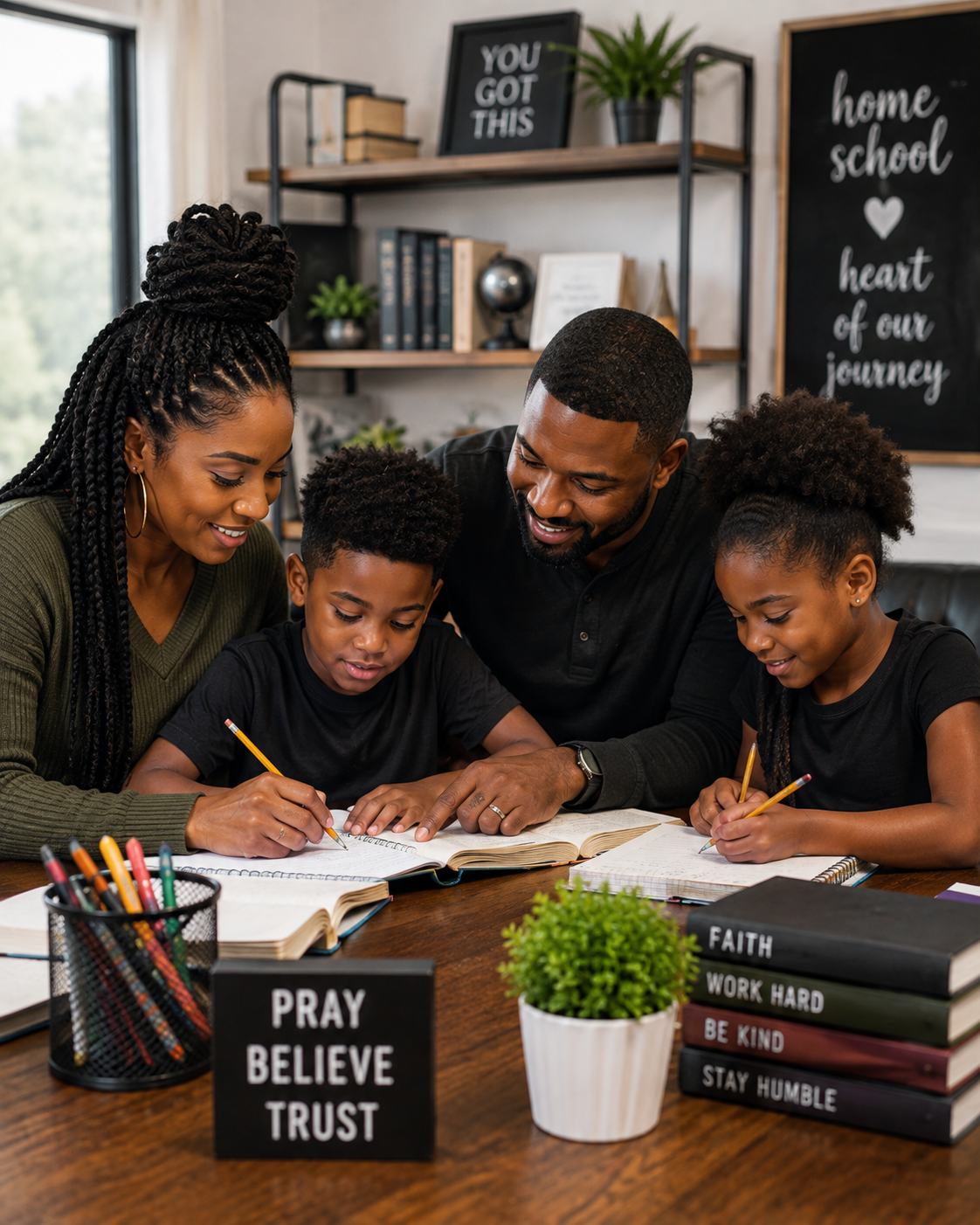
Q1) Why did you and your husband decide to homeschool?
Sister Aisha Foote:
My husband and I had always talked about homeschooling since middle school. Both of us worked in public education, and neither of us saw any really good middle schools from the inside out, so that plan was always there.
My husband was concerned about socialization and all the things he had positive experiences with in traditional school—sports, prom, and other activities people look forward to.
Once COVID hit, all of those things were taken away. Children across the country were home, and it gave us the opportunity to see what our children were actually getting from their education without focusing on things like prom, games, and socialization.
We quickly realized they were not really learning. My husband and I talked, and I told him, “I can do this.” He gave me the green light, and they never went back.
We had both positive and negative experiences in school from kindergarten up. Even through negative experiences, we kept trying to find a better school. At one point, their grandmother volunteered to help with different things at school. We also volunteered. When I look back, all the effort we put into trying to make school better could have been invested into homeschooling all that time.
All praises to the Most High. For other people, that time during COVID might have been traumatic, but for us it was a turning point. It pushed our family to look internally and make tough decisions we should have made years ago. I wish we had done it earlier, but that’s our story.
Q2) How did you address concerns about socialization?
Sister Aisha Foote:
There’s a saying: fear is just false evidence appearing real. The socialization piece was definitely on my husband’s mind, and on mine too. But the reality is, our children are more socialized than many kids who go to school.
It’s interesting to watch them in environments with children who attend public school. Some of those kids want to be on their phones all the time and have a hard time having real conversations, while our kids are talkative and can speak to adults and children.
These days, kids in school are often more anti-social. When you’re in school, you’re told to be silent all day, and you can only really talk at recess. Once you get to high school, that doesn’t exist. For many children, school becomes more like a pipeline to prison rather than true preparation for the world.
With homeschooling, we do our work during the day, but they have freedom to take breaks and socialize with each other. We have two children, but we also do a lot in the community. They’re part of organizations and groups, and through church they have many healthy opportunities to socialize with peers and with older and younger members of the community.
Socialization should be part of your curriculum as a homeschool parent—it cannot be a secondary thought.
All praises to the Most High, we started a homeschool group through our church, and we do once-a-month field trips. That may not sound like a lot, but compared to schools doing one or two field trips a year, once a month is a lot.
They see their church friends every week. They’re also on teams—baseball, golf. They’re members of different clubs. One is in robotics. Another does a Ranchers Club. Over the years we’ve done chess clubs and STEM clubs. There are many resources out there. If homeschool moms do research on what’s happening in their local area, there are opportunities to socialize as much or as little as you want.
Q3) What does “education” mean in your home beyond academics?
Sister Aisha Foote:
Education is more than academics. Our goal is to build a whole human—someone who is sound spiritually, physically, mentally, and financially. A whole person who can function in society.
When we first brought our kids out, the first two years we used a free online curriculum that teaches emotional intelligence and focuses on learning how to teach yourself. The first step for us was biblical education.
For the first six months, we mainly did math and reading the Bible. I realized after we took our children out that I knew my clients better than my own children. I’m a full-time school speech pathologist, and what I mean is I knew my clients’ learning styles better than my own children’s.
So I had to step back. Our form of “unschooling” looked like focusing on math and Bible at first. Bible works for history, reading, and even geography—so many different areas. That time allowed us to focus deeply on those two subjects.
After the first year, our son who had tested two years behind was now a year ahead. Our other son, who was already a year ahead, became four years ahead after that year.
Homeschooling showed us the power of focusing on the whole child—starting with the spiritual. Scripture teaches that the wisdom of this world is foolishness to the Most High. We can tap into a higher power who can show us what our children need.
Homeschooling also allows you to meet your child’s needs. You can take time to learn your child first—how they learn and what they need.
That emotional intelligence curriculum helped. In school, children are kept busy and told what to do every moment. They don’t have opportunity to find out who they are. During that time, one child taught himself piano. Another discovered he was an artist. Those gifts came out because they had space outside the traditional system. In the end, they also excelled academically—even while focusing on the Most High first and their other needs physically, mentally, and emotionally.
Q4) What advice would you give a parent who wants to start homeschooling?
Sister Aisha Foote:
First, decide what your end goal is and why you’re doing it. If you’re married, as a wife, sit down and ask your husband what his vision is for the children and what he wants them to learn. Have a conversation about your goals as a family. Then you can figure out how you want to do it and what it will look like for your home.
I highly recommend getting a mentor. For me, it was invaluable. Shout out to Melanie Scott—she spent time with me, shared what she was doing with her boys, and even made videos showing her classroom. Those videos helped our homeschool group members who were just starting.
I don’t homeschool exactly like Melanie, but she gave me an idea of what was possible, and we made it our own. It was helpful to learn from someone who had done it and see the success she and her family experienced. We pulled different things we could use, while still making it fit our home.
There’s more than one way to do it. Start with your family goals, then reach out to people to get ideas. There are different models. Some people use one curriculum for everything. Some use co-ops, where parents offer classes together. Some do school online or public education at home. Do what works for your family, but let your goals guide your decisions.
Q5) How do you align homeschooling with your children’s future goals?
Sister Aisha Foote:
It’s important to look
at future goals and align education. It starts with the vision you and your husband have for your children. We work backwards—look at where we want them to go and plan from there.
When they were younger, it was about exposure, exposure, exposure. We prayed and asked the Most High to reveal our children’s gifts so we could cultivate them. We put them in a little bit of everything to see what would stick. That’s how we found their unique gifts.
Now that they’re in high school, they’re more settled in what they want to do. One wants to be an engineer. Another wants to be a veterinarian. So we look for summer programs and opportunities that align with those goals.
We also look at class requirements. For science fields, there are certain math levels that need to be completed by middle school. If I didn’t know they wanted science paths, they might not have been on track. Now that we have one in high school, we look at college requirements and make sure prerequisites are met, while also providing extracurricular experiences aligned with their career goals.
Q6) How do you help your children find and cultivate their gifts?
Sister Aisha Foote:
We start with prayer. We ask the Most High to reveal their gifts so our eyes are open to see it.
Then it’s exposure, exposure, exposure—especially when they’re little. Put them in different activities so they can show what’s inside.
Also, the power of boredom. Schedule time with no direction from you, no electronics, no TV—just go find something to do. That’s how our children taught themselves piano, discovered art, and developed creativity. Every year we find something new. Now one is creating music—making beats and more.
So: prayer, exposure, and boredom are our go-to ways to help our children find their gifts. Cultivating those gifts comes through extracurricular activities and opportunities that support what the Most High has shown us.
Q7) How do you support a child who learns differently or has a learning disability?
Sister Aisha Foote:
Homeschooling allows you to adjust your teaching style to your child’s learning style. The first step is figuring out how your child learns. That applies to all children. What looks like a learning disability may be a difference in learning style.
Once you identify how they learn—auditory, hands-on, needing movement—you can build lessons around that. I taught English differently for each child. With boys, I incorporated movement, music, and rhythm—even through middle school—because it helped them remember.
Also, don’t be afraid to look outside traditional curricula. We found a math program that taught times tables through stories. One child struggled with memorization for a long time, but once we found it—Timetales, I believe—he understood immediately and it stopped being an issue.
Don’t assume your kids will fall behind. We spent the first six months mostly on math and Bible and people might think they’d be behind, but they ended up ahead by the end of the year.
If it is a disability, there are resources. I recommend expert help when you know your child has a learning disability. Don’t be afraid to get support. That’s true for all children. For example, I’m not a math person—I’m the English girl—so we invest financially in strong math programs. My husband can help sometimes, but he’s not available to teach a full curriculum. So we put resources where I’m weak.
There are also scholarships available for homeschool parents supporting children with disabilities. And even in homeschooling, the public school system is still required to provide certain therapies through the federal government. Those services can help your child along their educational journey.
Q8) What does your daily schedule and assessment look like?
Sister Aisha Foote:
We do have a schedule and a start time. From elementary through middle school, I made the schedule. Once they hit high school, they create their own schedule. Even in middle school, I give flexibility as long as everything is completed.
We’re not very rigid with time blocks like “9:00–9:30 math.” Instead, they work through subjects based on what needs more time.
We’re not big on testing because I don’t find it to be an accurate description of where a child truly is. If you work with your child daily, you know where they are. In North Carolina, we are required to test annually, so we do it. It provides some general information, but daily work gives me more.
We strongly believe in project-based learning—doing projects, explaining what they learned, and teaching it back. They write what they’ve learned, which shows understanding. Having one child teach another also shows mastery.
As they get older, they have more tests within certain classes, but we still rely heavily on project-based assessments, especially outside of math.
Q9) How do you manage self-care and avoid burnout as a homeschool parent?
Sister Aisha Foote:
They call it the balancing act because it’s not real. Something will always be out of balance. I don’t try to keep everything balanced, but I do try to maintain self-care.
We might spend four hours homeschooling, then four more hours doing family things. Maybe I only get 30 minutes to an hour for myself, but that consistency helps me stay healthy physically, spiritually, and mentally.
It’s about what you do with the time you have. Be intentional: start your day with scriptures, make time to work out—even a walk—clear your head. If you’re married, we believe in date nights. And self-care can look like a manicure or whatever restores you.
Also ask for help. You chose homeschooling, so I don’t mean help teaching—but tap into your village. If someone can babysit sometimes so you can get away, do that. Having a network of other homeschool moms helps, especially in the beginning. When you write curriculum for your children, include something for you—your own goal for the semester or year.
Q10) What role does technology play in your homeschool?
Sister Aisha Foote:
Technology is part of our model. One child wants to be an electrical engineer and is on a robotics team. We try to use technology as a tool and not let it overcome our children.
They have Chromebooks with timers and permission settings for websites. That has helped, and it’s free with Chromebooks. I believe it’s called Family Link. We also make sure they have time away from technology—to talk, think, move, exercise, and engage outside of screens.
Having them involved in activities helps reduce time for video games and constant screen use. Not that they never do those things, but parents need to be vigilant. Studies show heavy social media use is linked to depression and suicidal thoughts. These platforms are designed to be addictive. We guard our children by giving structure while their brains are developing.
We don’t believe in social media in our home, and we have hard rules. Even our children recognize the distraction and understand why we limit it. Entertainment isn’t wrong, but distractions should not take over. We aim for healthy ways to have fun and express themselves outside of being on technology all day.
Q11) What would you say to someone who feels called to homeschool but is afraid?
Sister Aisha Foote:
It’s not always moms. There are single dads and fathers who are very involved with their wives in education. This is not just a woman’s thing. It’s important for children—especially boys—to learn from their fathers. Even daughters benefit greatly. I always say the love of a father can save a nation. Sitting at their father’s feet, learning wisdom and seeing his example matters.
To any parent feeling fearful: false evidence appearing real. If it doesn’t work out, you can always put your kids back in school. But you’ll unlock something in your child. Even if life circumstances force you to send them back, you’ll still see how much they were able to grow and find who they are.
For us, we wish we had done it earlier. That’s the only regret. So jump in. Do research, get a mentor, but do it—like Nike says, just do it.
It won’t be perfect. You will fail at things, and that’s okay—regular teachers do too. The beauty of homeschooling is you have time and space to pivot, change direction, and try something different.
If you have a weak area, don’t be afraid to get help. We invest financially in a strong online math program because math is a weak point for me. That’s fine.
Most importantly, keep the Most High as your guide. That’s what your whole family needs to do it successfully. Shalom.

NURTURED BY DESIGN:
A FAITH-CENTERED APPROACH TO BIRTH, BREASTFEEDING AND MOTHERHOOD
WITH TIFFANY EMBRYO
Introduction
In a world where motherhood is often rushed, medicalized, and disconnected from its spiritual roots, one Labor and Delivery nurse is helping women return to a place of knowledge, confidence, and divine alignment.
As a childbirth educator and lactation specialist, her mission is clear: to equip women with the tools they need to participate fully in their care, advocate for themselves, and embrace motherhood as the Most High intended.
Section I: The Foundation of Her Calling
A Journey into Purpose
Her journey began at the bedside.
Working as a Labor and Delivery nurse, she witnessed a consistent pattern—women entering birth unprepared, uncertain, and often fearful.
“Many women go along with the proposed plan of care as if they have no choices—simply because they don’t know what questions to ask or how to advocate for themselves.”
This realization ignited her calling.
She recognized that education transforms outcomes—especially in breastfeeding, where knowledge significantly increases success.
Faith as the Driving Force
Her work is deeply rooted in faith.
“My faith drives me to be a supporting vessel to others.”
She explains that faith shapes every aspect of motherhood—from how women approach birth to how they nourish their children—often standing in contrast to societal norms.
The Divine Design of Motherhood
At its core, motherhood is sacred.
“We are their first and main teachers.”
She emphasizes that the Most High designed mothers to nurture, guide, and establish trust, especially in the early years of a child’s life.
Section II: Preparing for Birth—Mind, Body & Spirit
Whole-Woman Preparation
Preparation for birth is not just physical—it is holistic.
● Spiritual health strengthens emotional resilience
● Mental well-being supports peace during labor
● Physical conditioning reduces complications
“The more prepared you are, the more at ease you will be with the process.”
Breaking the Myth of Natural Birth
One of the greatest misconceptions?
That natural childbirth is impossible.
“It absolutely can be done.”
She reframes pain not as something to fear—but something to prepare for and work through with confidence.
Spiritual Readiness for Labor
She encourages women to remain anchored in scripture and faith:
● John 16:21 — A reminder of joy after travail
● Isaiah 41:10 — A promise of strength and divine support
Affirmations she shares with mothers:
● “Let’s focus on one contraction at a time.”
● “God has given you all the strength you need.”
● “Every contraction brings you closer to your child.”
The Body as a Temple
Preparation also includes honoring the body.
“The Bible refers to our bodies as temples of the Holy Spirit.”
Proper nutrition, movement, and rest:
● Reduce risks like preeclampsia and gestational diabetes
● Improve endurance for labor
● Support emotional balance through hormone regulation
She offers a powerful analogy:
“No one runs a marathon without training—birth is no different.”
Section III: Labor, Advocacy & Support
The Power of a Birth Plan
A birth plan is more than a document—it is a declaration of intention.
It may include:
● Pain management preferences
● Accepted or declined interventions
● Labor positions
● Desired environment and atmosphere
“It allows you to express your desires before the intensity of labor begins.”
Advocacy & Informed Consent
This is especially critical for women of color.
“You do not have to simply acquiesce to someone else’s plan.”
Education empowers women to:
● Understand medical terminology
● Explore alternatives
● Participate actively in their care
Advice for Natural Birth in a Hospital Setting
Her guidance is direct and practical:
● Be informed
● Stay flexible
● Understand your circumstances
Most importantly:
“Avoid induction without a medical indication.”
She explains that unnecessary interventions can lead to a cascade of additional procedures, making unmedicated birth more difficult.
The Role of Support Partners
Support during labor is essential.
Partners can:
● Attend childbirth classes
● Learn coping techniques
● Provide physical and emotional support
“It is empowering to have people who do more than just watch.”
Section IV: Breastfeeding—Nourishment by Design
The Power of Breastmilk
Breastfeeding benefits both mother and child:
● Strengthens emotional bonding (oxytocin release)
● Boosts the baby’s immune system
● Reduces illness and infections
“Breastmilk is like customized medicine for your child.”
Long-Term Breastfeeding Benefits
Extended breastfeeding (up to 2–3 years):
● Supports cognitive development
● Strengthens emotional attachment
● Reduces risk of chronic illness
Overcoming Challenges
For mothers facing difficulties:
“Seek help early—and be patient.”
Common issues such as latch problems or low supply often have solutions when properly assessed.
Standing Firm Amid Pressure
Societal and familial pressure can be strong.
Her encouragement:
“Remember why you started. Stay rooted in your convictions.”
Gentle, Biblical Weaning
Weaning varies by child, but often aligns with biblical patterns of 2–3 years.
Gentle methods include:
● Gradually reducing feedings
● Allowing child-led transitions
● Adjusting routines
● Leaning on support systems
“Do it with patience and love—for yourself and your child.”
Section V: Wisdom for the Journey
Biblical Examples of Motherhood
She draws inspiration from:
● Jochebed (Mother of Moses)
● Hannah (Mother of Samuel)
“Their stories remind us of faith, sacrifice, and strength.”
Overcoming Fear
Her message is simple but powerful:
“You are capable. Our foremothers have done it.”
Faith transforms fear into trust.
Encouragement for Women Walking Alone
Even without immediate support:
● Seek community resources
● Join support groups
● Connect online if needed
“If you are reading this, know that you do have support.”
Mothering with Intention
Intentional motherhood often requires sacrifice.
“Sometimes we forgo convenience to give our children what is best.”
This includes decisions about:
● Birth
● Nutrition
● Education
● Values
Final Words: A Call to Embrace the Journey
Her closing message is both gentle and firm:
“Embrace the journey. Remember your ‘why’ and stay committed to it.”
With faith as the foundation, women are reminded that they are never alone—and that the Word of the Most High will keep them grounded every step of the way.
“God has already given you everything you need for this moment.”
SUBMISSION OF A WIFE:
WITH CHASADAH ISRAEL






Submission.
In recent times, this word has become one of the most divisive and misunderstood, with women often being on opposing sides of whether submission is meant to work for us or against us. While this world pushes the idea of submission being a way to keep women in chains under the oppression of the patriarchy, as women of faith we have to understand what submission is, and what that means for us according to God and His Word.
What is “submission”?
One of Webster’s dictionary definitions for the word “submit” is, “to yield oneself to the authority or will of another,” or “surrender.” This also aligns with some of the biblical usages of “submit” that can be found in the New Testament, such as, “to subject one’s self, obey,” and “to submit to one’s control.”
While these definitions may sound a bit scary at first, do we truly know what they mean? And more importantly, what do they mean for us as we strive to be women of God?
Biblical Examples of Submission:
The Bible provides us with a myriad of different scriptures outlining what submission looks like for women, as well as examples of women who were rewarded for their submission.
Some scriptures that are often brought forth are from Ephesians 5, and 1 Peter 3:22
“Wives, submit yourselves unto your own husbands, as unto the Lord.
23 For the husband is the head of the wife, even as Christ is the head of the church: and he is the saviour of the body.
24 Therefore as the church is subject unto Christ, so let the wives be to their own husbands in every thing.” Ephesians 5:22-24 (KJV)
- 1 Likewise, ye wives, be in subjection to your own husbands; that, if any obey not the word, they also may without the word be won by the conversation of the wives;
- while they behold your chaste conversation coupled with fear.
- Whose adorning let it not be that outward adorning of plaiting the hair, and of wearing of gold, or of putting on of apparel;
- but let it be the hidden man of the heart, in that which is not corruptible, even the ornament of a meek and quiet spirit, which is in the sight of God of great price.
- For after this manner in the old time the holy women also, who trusted in God, adorned themselves, being in subjection unto their own husbands:
- even as Sara obeyed Abraham, calling him Lord: whose daughters ye are, as long as ye do well, and are not afraid with any amazement.1 Peter 3:1-6 (KJV)
There is a lot that we can take from these two scriptures alone, like the explanation of why we submit that Ephesians provides, and the description of what submission looks like from 1 Peter.
Peter also gives us Sarah as an example, and while there are several instances throughout the biblical records of our foremother’s submission to her husband, Genesis chapter 18 is a key example.
In Genesis 18:1-15, Abraham and Sarah are visited by angels on their way to Sodom. Abraham immediately opens his home to them and calls for Sarah to quickly prepare food for their visitors.
Sarah doesn’t object and she doesn’t ask questions, instead she follows her husband’s instruction.
As a result of Sarah’s obedience (or submission) to her husband, she is rewarded with the promise of bearing a son, even past her childbearing age (verses 9-14).
Husbands also Called to Submit:
While we as women are called to submit to our husbands, we must also remember that our husbands are called to submit as well. 1 Corinthians 11:3 gives us the order by saying, “But I would have you know, that the head of every man is Christ; and the head of the woman is the man; and the head of Christ is God”(KJV).
Order is brought to us by The Most High, and even Christ our saviour must submit to the will of the Father.
The Most High gives us order for our protection, as expressed in Romans 13
“1 Let every soul be subject unto the higher powers. For there is no power but of God: the powers that be are ordained of God.
2 Whosoever therefore resisteth the power, resisteth the ordinance of God: and they that resist shall receive to themselves damnation.
5 Wherefore ye must needs be subject, not only for wrath, but also for conscience sake.” Romans 13:1-2, 5 (KJV)
[Submission to Husband = Submission to Ahayah]
Now at this point I want to pose a question for us to truly reflect on - If you can’t submit to your husband in the flesh, how can you submit to your Father in th e Spirit?
If this question seems too difficult, 1 John may help us look at it in another light:
“20 If a man say, I love God, and hateth his brother, he is a liar: for he that loveth not his brother whom he hath seen, how can he love God whom he hath not seen?
21 And this commandment have we from him, That he who loveth God love his brother also.” 1 John 4:20-21 (KJV)
Submitting to our husbands is required of us by The Most High, and shows our husbands that we trust them to lead us in the way that is ordained to them by our heavenly Father.
No, it may not always be easy, but the spiritual growth we gain from it transforms us and transfers into other aspects of our walk as well.
Colossians 3:18 brings us to this righteous conclusion, “Wives, submit yourselves unto your own husbands, as it is fit in the Lord.”
Shalom shalom, my sisters